
· by Michael Blair, Nashville's Appliance Repair
The call usually starts with ice cream. It is soft, the ice trays are slow, the packages on the top shelf give a little when you press them, and yet the milk on the fridge side is as cold as ever. That split is a clue, because on most frost-free refrigerators the cold is made at one set of coils behind the freezer’s back panel. When the freezer is the side falling behind, we look at that panel and what sits behind it before anything else on a refrigerator and freezer repair visit. This is what we check, in order, and how to decide what to do with the food in the meantime.
Why is my freezer not freezing when the refrigerator side is cold?
Most often, cold air is not moving across the freezer the way it should, or frost has closed off the coils that make it. GE Appliances’ page on defrost systems places the evaporator section at the rear of the freezer compartment, which is why trouble there tends to show up in the freezer first.
We work from the outside in. First the door: whether it shuts on its own and whether the gasket meets the cabinet all the way around, since a freezer door left slightly open can frost up quickly. Then the setting, in case a dial got bumped while someone reached for the ice. Then the inside: bags and boxes stacked hard against the back wall can block the openings the cold air moves through. After that we listen for the evaporator fan behind the panel with the door switch pressed. A fan that hums but does not turn, or does not start at all, leaves the freezer cold only near the coils.
If none of those explain it, we take the back panel off and look at the coils themselves. That is where the defrost system comes in.
- Freezer door closing fully, gasket touching the frame all the way around
- Temperature setting where it belongs
- Food clear of the vents and the back wall
- Evaporator fan running when the door switch is held in
- Frost on the back panel or on the evaporator coils behind it
What does the defrost system do, and how can you tell it has failed?
It melts the frost off the evaporator coils on a schedule so air can keep passing through them. GE describes two kinds on frost-free refrigerators and upright freezers: a time-based system with a defrost timer, which counts compressor running time and usually defrosts every 8 to 15 hours depending on the model, and a usage-based system GE calls Adaptive Defrost. Either way, the system switches on a heater in the evaporator section, the heater melts the frost, and then it turns off.
GE also describes what a working defrost sounds like, which helps rule out a false alarm. During defrost there is no running, fan or compressor noise, most models stay in it for roughly 25 to 45 minutes, usually once or twice a day, and dripping or sizzling while it runs is normal. A refrigerator that goes quiet for half an hour and then starts again is doing its job.
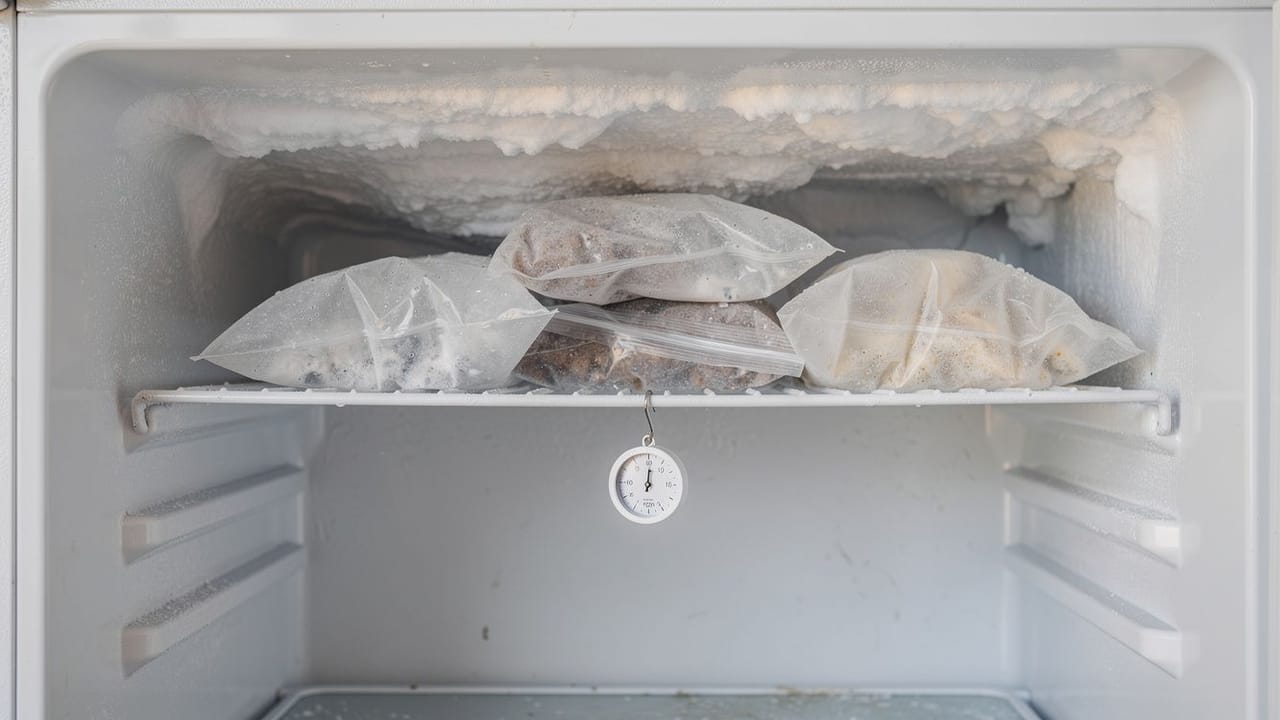
A failed defrost looks different. Frost builds up on the coils a little more with every cycle the heater misses, until it blocks the air. From the front you may see a white coat of frost across the back panel of the freezer, or feel very little air coming from the vent. Behind the panel, the coils are packed in ice instead of showing bare metal and fins. At that point we test the parts of the defrost circuit on that model, which differ between a timer system and an adaptive one, and replace the one that has quit. That test is where our refrigerator and freezer repair work goes once the door, setting, vents and fan have checked out.
Can you keep the food in a freezer that stopped freezing?
Some of it, if you check it rather than guess. The FDA’s guidance on refrigerator thermometers says the freezer should be at 0°F and the refrigerator at 40°F or below, and recommends a freestanding appliance thermometer in each, since a dial on the control panel is a setting, not a reading. The same page says frozen food that still has ice crystals, or is at 40°F or below, can be safely refrozen or cooked, and that if you are unsure how long it has been at or above 40°F, you should throw it out.
A freezer that is failing slowly does not follow a clock the way a freezer without power does. Ready.gov’s power outage guidance says a full freezer will hold its temperature for about 48 hours and a refrigerator will keep food cold for about four, with the doors kept shut. That is useful during a storm outage, but a freezer losing ground to frost may have been drifting warmer for days before anyone noticed the ice cream. So we would rather you measure than count. Put a thermometer in the freezer, check the packages one by one, and move what is still frozen to the fridge side, a cooler with ice, or a neighbor’s freezer until the repair is done.
Ready.gov’s rule for the rest is plain: throw out food that has been at 40°F or higher for two hours or more. The FDA adds that food can make you sick without looking or smelling spoiled, so a package that seems fine is not proof that it is.
Garage freezers, chest freezers, and when to call
A second refrigerator or upright freezer in an unconditioned garage has a harder job through a Middle Tennessee summer, when the air around it stays hot and damp for weeks. Every door opening lets in humid air that ends up as frost on the coils, and the compressor runs longer to keep up. A defrost part that is close to failing often gives out first on that unit.
Many chest freezers and compact models are manual defrost, with no heater at all. For those, GE says to defrost whenever the frost gets to between a quarter and a half inch thick. Past that, the frost insulates the food from the cold walls and the freezer struggles to keep things hard, which is a maintenance job rather than a repair. On a frost-free model, though, thick frost is the symptom, not the cause. Melting it out by hand clears the coils for a while, but if a defrost part has failed, the frost comes back.
If the freezer side is the one holding and the fridge side is warm, that is the reverse problem, and when a refrigerator stops cooling walks through it. If the freezer is soft, frost is on the back panel and the door and setting check out, it is time for a diagnosis. We work across Davidson County, Old Hickory included, from our Nashville appliance repair page, and on an older unit the choice between a part and a new freezer is laid out in whether an appliance is worth repairing. Send the model number from the label inside the door through our estimate request, and tell us whether there is frost on the back wall.
Sources
- GE Appliances: Refrigerator and Freezer, Types of Defrost Systems — Time-based and adaptive defrost; timer defrosts every 8 to 15 hours; heater in the evaporator section at the rear of the freezer; 25 to 45 minutes once or twice a day, quiet, dripping normal; manual defrost at a quarter to half inch of frost.
- U.S. Food and Drug Administration: Refrigerator Thermometers, Cold Facts about Food Safety — Freezer at 0°F, refrigerator at 40°F or below; appliance thermometers; refreeze or cook food with ice crystals or at 40°F or below; when unsure, throw it out; spoiled food may not look or smell spoiled.
- Ready.gov (FEMA): Power Outages — Refrigerator keeps food cold about four hours, a full freezer holds about 48 hours; throw out food at 40°F or higher for two hours or more.
FAQ
Freezer Not Freezing but the Fridge Is Still Cold — questions
Why is my freezer not freezing but the refrigerator is cold?
Usually because cold air is not moving across the freezer or frost has blocked the coils behind its back panel, where GE places the evaporator. We check the door and gasket, the setting, food blocking the vents, the evaporator fan, and then frost on the coils that the defrost heater should be melting.
Can I refreeze food that thawed in a freezer that stopped working?
If it still has ice crystals or is at 40°F or below, the FDA says it can be safely refrozen or cooked. Check each package with a food thermometer or an appliance thermometer. If you cannot tell how long the food has been at or above 40°F, the FDA says to throw it out.
Does frost buildup in the freezer mean the defrost system has failed?
On a frost-free model, heavy frost across the back panel or packed around the coils usually means part of the defrost system has quit, since GE says a timer system should melt the coils clear every 8 to 15 hours. On a manual-defrost chest freezer, frost is normal and is yours to remove.
How cold should a freezer be?
The FDA says 0°F, with the refrigerator side at 40°F or below. It recommends a freestanding appliance thermometer in each compartment, because the control dial shows a setting, not what the air inside actually is. A freezer reading well above 0°F with the door kept shut is worth a diagnosis.
Should I unplug the freezer to defrost it?
On a manual-defrost chest or compact freezer, yes, once the frost reaches a quarter to half an inch, which is GE’s guide, with the food moved somewhere cold first. On a frost-free model, melting the ice clears the coils only for a while; if a defrost part has failed, the frost builds back.